***
title: Use the X-EI SIP header
subtitle: null
slug: x-ei-sip-header
description: null
-----------------
The `X-EI` header still works, but Synthflow now accepts any custom `X-*` SIP header on inbound calls. For most use cases, [arbitrary X-headers](/sip-x-headers-in-prompts) are simpler and more flexible.
The `X-EI` SIP header lets you pass downstream call metadata from your SBC, PBX, or carrier into Synthflow so agents, analytics, and post-call workflows immediately inherit that context. Use it any time you need to correlate distributed call legs or identify where a transfer originated.
## When to use X-EI
* Preserve a platform-native call ID (`Twilio CallSid`, carrier GUID, etc.) for every leg of a transfer so custom actions can cross-reference it without re-mapping IDs.
* Carry your own external call identifiers from PBXs or CRMs to keep reporting aligned between Synthflow and legacy systems.
* Track diversion chains even when carriers strip the standard Diversion header—Synthflow can reconstruct it through `X-EI`.
## Header format
`X-EI` expects a semicolon-delimited list of tokens. Each token begins with one of three prefixes followed by a dot and the value:
```
(S|E|O).([^\;]+);
```
You can send any subset of tokens in any order. All combinations are valid.
| Token | Purpose | Example |
| :---------------- | :---------------------------------------------------------------------------------------------------------------------- | :---------------- |
| `S.` | Synthflow's Call ID. | `S.abc123;` |
| `E.` | Your own call ID from a PBX, CRM, or ticketing system so every leg of the call maps back to your records. | `E.crm456;` |
| `O.` | Original caller or diversion history. Synthflow proxies fall back to `X-Diversion` if the Diversion header is stripped. | `O.+15551234567;` |
```
X-EI: S.abc123;E.crm456;O.+15551234567;
```
Avoid semicolons in the token values. Each token ends with `;`, so additional semicolons break parsing.
## Using the values in Synthflow
Once the INVITE reaches Synthflow, the platform maps the token values to reusable placeholders for prompts, actions, and post-call workflows:
| Placeholder | Source token |
| :-------------- | :---------------- |
| `` | `S.` |
| `` | `E.` |
| `` | `O.` |
You can call these placeholders inside before-the-call or during-the-call custom actions without additional setup. The `E.` token also surfaces as `call.external_id` in the [post-call webhook response](/webhooks).
## Example: Passing external\_id via Twilio Dial SIP
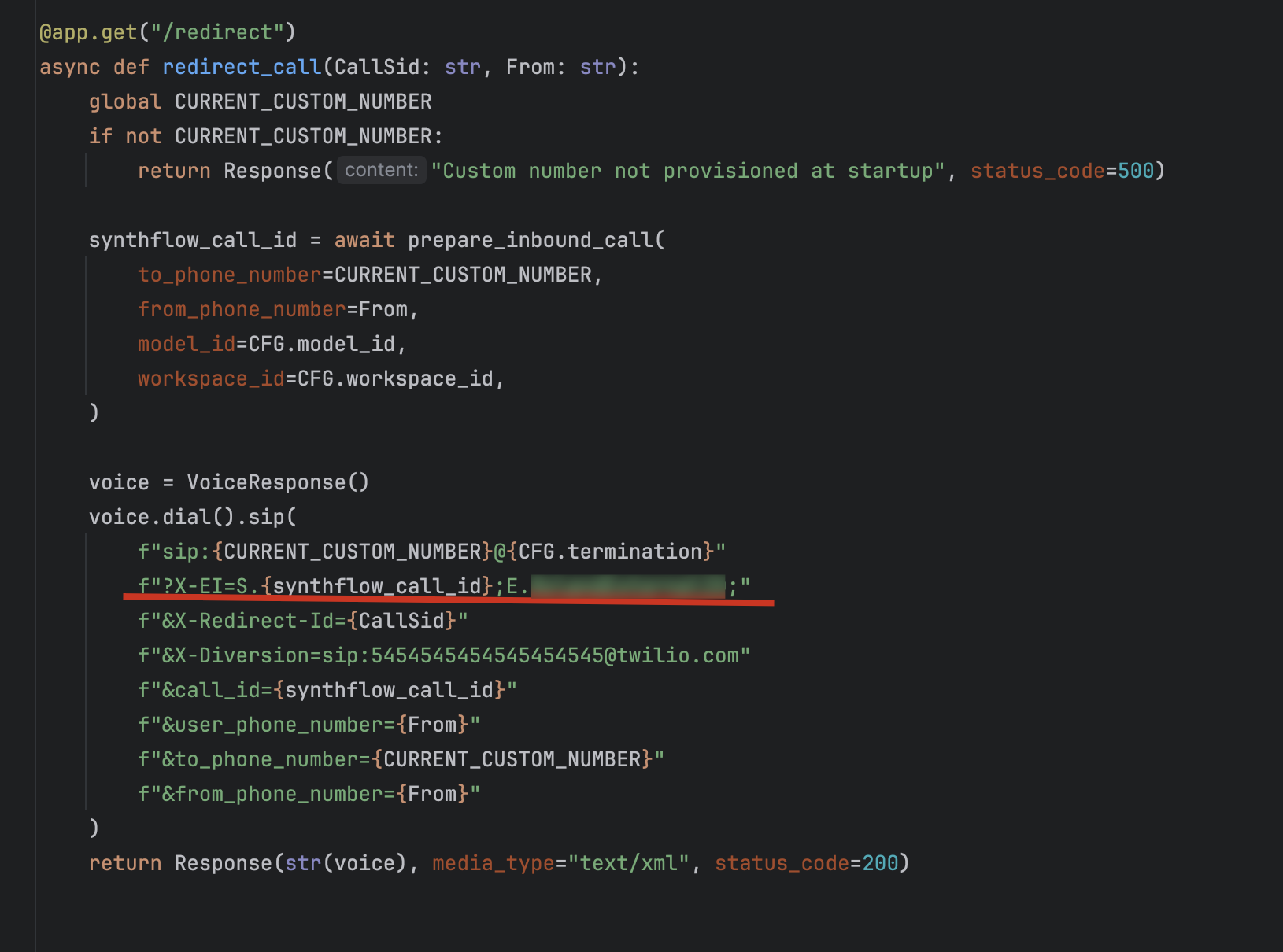
```
TwiML snippet
voice.dial().sip(
f"sip:{CURRENT_CUSTOM_NUMBER}@{CFG.termination}?X-EI=S.{synthflow_call_id};E.someExternalID;"
)
```
In this example, we are passing E.someExternalID inside the Dial().sip(...) URI.
## Deployment notes
* Combine any tokens you need—`S + E`, `S + O`, or all three.
* Keep values short to avoid SIP header size limits, especially on UDP trunks.
* If upstream carriers remove Diversion, Synthflow merges the contents of `X-Diversion` into the `O.` token automatically.
* Ensure the header remains URL-encoded if you add it to a query string inside your SIP target URI.
## Troubleshooting checklist
* Header missing? Verify your SBC forwards custom SIP headers end-to-end.
* Wrong `external_id` in webhooks? Confirm the `E.` token matches the format `E.;` and isn’t URL-escaped twice.
* Diversion chain incomplete? Check whether the carrier strips Diversion—Synthflow only reconstructs it if `X-Diversion` is present.