

Variables
Variables are placeholders that let your agent work with dynamic data. Use them in prompts, Custom Actions, call transfers, SIP headers, and webhook payloads by wrapping the variable name in curly braces, for example {call_id}.
Synthflow supports four types of variables:
System variables
System variables are built-in values that Synthflow populates automatically for every call. You do not need to define them.
Example
Pass system variables in a Custom Action request body to identify the call in an external system:
You can also reference system variables in prompts:
Pre-call variables
Pre-call variables, also called custom variables, are values you pass into the agent before the conversation starts. They inject external context without requiring the agent to collect it during the conversation.
Use pre-call variables to personalize conversations with user details, CRM data, campaign context, account status, or other backend data.
How to use pre-call variables
- Identify the data you want to inject (for example, a company name or user role).
- Include the data in the
custom_variablesfield of your API request. - Reference the values in prompts, actions, transfers, SIP headers, or webhook payloads.
For API-specific details, see Dynamic prompt injection.
Collected variables
Collected variables are values gathered from the user during the conversation after the user provides the requested information.
Use collected variables when the agent needs to remember information for later steps, such as a caller’s name, email address, appointment date, issue type, or transfer reason.
How they work
- The agent asks for specific information.
- The user provides the response.
- Synthflow stores the response as a variable, for example
{user_email}or{appointment_date}. - The variable can be used later in prompts, Branch nodes, Custom Actions, transfers, SIP headers, and webhooks.
In Flow Designer, Conversation nodes are the primary way to define collected variables. You can also use the Variables drawer to view available variables, see where they are used, and navigate back to their source.
Post-call webhook payload
Post-call webhooks include collected values in the collected_variables field when they are available. Only variables with collected: true are included.
For the full payload shape, see Post-Call Webhook.
Action result variables
Action result variables store data returned by Custom Action API calls. When a Custom Action executes, the response is parsed and stored in variables you can reference later.

How they work
- A Custom Action sends an API request (GET, POST, PUT, etc.).
- The external API returns a response.
- The response data is stored in action result variables.
- Reference the results in prompts or pass them to other actions.
For example, if a Custom Action calls an order-status API and returns {"status": "shipped"}, you can reference {status} in your prompt or in subsequent actions.
For more details on configuring Custom Actions and using their responses, see Custom Actions.
Reference action results in your prompt
In the agent Prompt editor, type < and Synthflow will list the available data of the response of your initialized custom action. You can also use the Action results control in the prompt toolbar.

In-call messaging replies
In-Call Messaging actions populate a dedicated reply variable when the customer responds by text:
The variable is set as soon as the reply arrives, whether the action was configured to block the agent until then or to let the call continue in the background. If no reply arrives before the call ends, the variable remains empty.
Action placeholders and mapping
Several actions let you embed placeholders with angle-bracket names, for example <customer_name> or <queue_ref>, in specific configuration fields such as the SMS message body, call transfer targets or SIP headers, or the lead_email input on real-time booking. Each distinct name becomes an input variable on that action.
After you attach the action to an agent, you map each input to its source: values collected during the call, system fields, pre-call variables (custom variables), action results from another step, or a fixed value you enter. These are the same families summarized in the overview table at the top of this page.
Choose how an input variable gets its value
When an action exposes an input variable, choose how Synthflow should fill that value when the action runs.
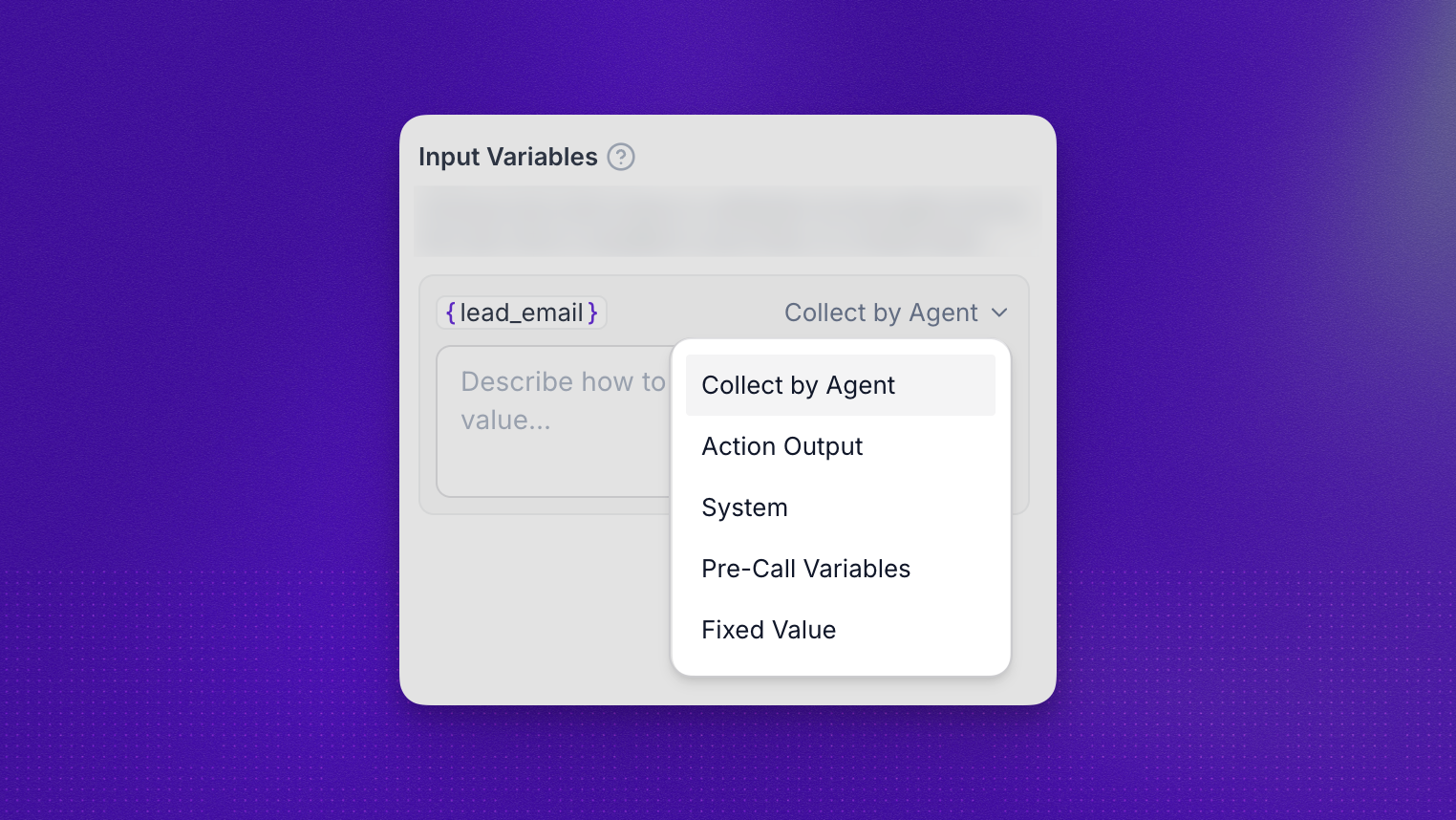
Field-by-field setup lives in each action guide:
Where to use variables
Angle-bracket placeholders on supported actions are covered in Action placeholders and mapping. Variables can also be referenced in several other places across your agent configuration:
- Prompts: Personalize your agent’s behavior, for example
"Hi {lead_name}, thanks for calling {company_name}.". - Custom Actions: Pass variables in API parameters or body fields on Custom Actions, shape JSON with placeholders, and reuse response fields in later steps.
- Real-Time Booking: When you attach real-time booking, define variables so details the caller gives you, like
<user_name>or<user_email>, flow into the booking request. - Call Transfers: On call transfers, define variables to capture context like
<caller_name>or<issue_type>for whispers, summaries, or SIP headers. - Send SMS: On Send SMS, define variables to personalize templates, for example
"Hi <customer_name>, your appointment is confirmed for <appointment_date>.". - Webhooks: Reference variables when configuring webhook payloads.
- Flow Designer nodes: Use variables in Conversation, Message, Branch, and Custom Action nodes in the Flow Designer.
- SIP headers: Pass system variables in SIP X-headers for telephony integrations, as described in Use SIP X-Headers in Prompts, Actions & Transfers.
FAQ
Are all variable types available in both Flow Designer and Single-Prompt agents?
Yes. System variables, pre-call variables, collected variables, and action result variables are available in both Flow Designer and Single-Prompt agents.